

Blog · Retirement
Retirement Risk: Sequence of Returns
Understanding the “Order of Returns”, or “Sequence of Returns” Risk in Retirement
Quick Summary
The distribution phase of retirement (when you take income), is different than the accumulation phase (when you are saving). You can weather negative returns while your are saving, but not so when you start taking money.
How do you mitigate this risk? You need buffer accounts/assets; assets you can tap which are not affected by the market, until those market accounts recover (see Mitigation Strategies section below).
For those who want to read more…
The Sequence of Returns Risk refers to the risk that the order and timing of investment returns will unfavorably affect the value of a retirement portfolio. This risk is particularly critical during the withdrawal phase of retirement. While the average return over a long period might be adequate, experiencing significant negative returns early in retirement can dramatically reduce the longevity of a retirement portfolio due to the need to make withdrawals when portfolio values are depressed. Like all risks in retirement, the longer you live, the more likely you will face this risk.
Impact of Early Losses: If a retiree encounters significant losses in the early years of retirement, they may have to sell a larger portion of their investments to cover their living expenses. This reduces the portfolio’s potential to recover when markets rebound, exacerbating the impact of those early losses.
Compounding Negative returns early in retirement combined with withdrawals can create a compounding effect, where the portfolio balance declines faster than it can recover, making it difficult to sustain withdrawals over the intended retirement period.
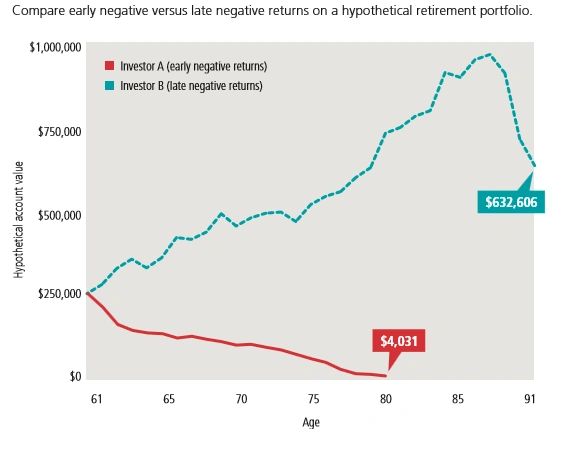
Example Scenario: Consider two retirees with identical portfolios and identical average annual returns over a 30-year retirement period. If Retiree A experiences negative returns early on, their portfolio value can be significantly lower in later years compared to Retiree B, who experiences positive returns initially and negative returns later. This difference occurs even though both portfolios may have the same average return over time.
See this example chart on Midland National’s FIA webpage
Mitigation Strategies:
Creating Buffer Assets
Cash Reserve: Maintain a cash reserve or a money market account sufficient to cover 1-3 years of living expenses. This allows the retiree to avoid selling investments during market downturns.
Laddered Bonds & Annuities: Use a laddering strategy where bonds mature at regular intervals, or when you turn on income from any number of annuities you’ve purchased.
Stable Value Funds: Invest in stable value funds which are designed to protect principal and offer steady returns, suitable for conservative portions of the retirement portfolio.
Dynamic Withdrawal Strategies
Guardrails Approach: Adjust withdrawal amounts based on portfolio performance. Increase withdrawals in good years and decrease them in bad years.
Fixed Percentage Withdrawal: (vs. fixed amount) Withdraw a fixed percentage of the portfolio each year, which automatically adjusts the withdrawal amount to the portfolio’s performance.
Diversified Investment Portfolio
Asset Allocation: Maintain a diversified portfolio across various asset classes (stocks, bonds, real estate, etc.) to spread risk.
Rebalancing: Regularly rebalance the portfolio to maintain the desired asset allocation, which can involve selling high-performing assets and buying underperforming ones, thus enforcing a buy-low, sell-high discipline.
Annuities
Immediate Annuities: Purchase an immediate annuity to provide a guaranteed income stream, reducing reliance on the investment portfolio.
Deferred Annuities: Consider deferred annuities that begin payouts at a later stage in retirement, providing a hedge against longevity risk. Similar to bond laddering.
Insurance Products
Long-Term Care Insurance: Mitigate the risk of high long-term healthcare costs depleting your retirement portfolio and potentially negatively impacting your spouse or children.
Cash Value Life Insurance: Can provide tax-free distiributions from excess account value to buffer market downturns. Also useful as a buffer asset, since IULs use a 0% floor when related indices go negative.
Practical Steps
Assess Risk Tolerance: Evaluate your risk tolerance and adjust your investment strategy accordingly, prioritizing stability and income over growth as you approach and enter retirement.
Professional Guidance: Work with a financial advisor to tailor these strategies to your specific situation, ensuring your retirement plan is robust against the sequence of returns risk.
Regular Reviews: Conduct regular reviews of your retirement plan and make adjustments as necessary to stay on track with your financial goals and mitigate emerging risks.
By understanding and planning for sequence of returns risk, retirees can better protect their portfolios from the adverse effects of market volatility and ensure a more secure and sustainable retirement income.