

Blog · Family
How Much Life Insurance Does Your Family Really Need?
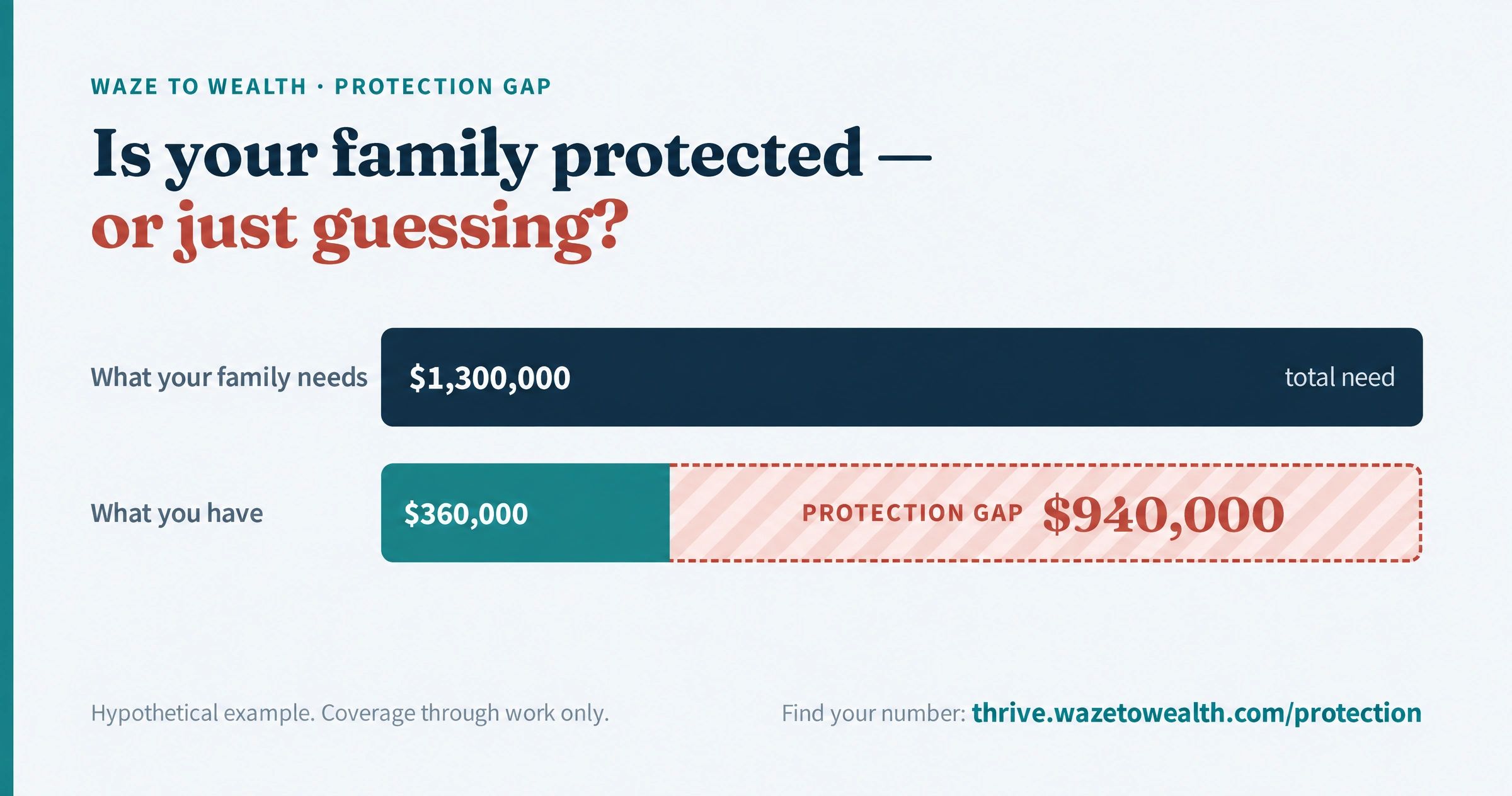
Are you protected — or just guessing?
Ask most people how much life insurance they carry and you’ll get one of three answers: “whatever I get through work,” “ten times my salary, I think,” or “I’m not sure.”
That’s not a plan. That’s a guess.
And a guess is fine right up until the day your family has to rely on it. At that point, the number either covers what they need — or it doesn’t, and there’s no second chance to get it right.
The good news: getting to a real number doesn’t take a financial degree. It takes about five minutes and an honest look at what your family would actually face without you.
Click or scan this QR code to use the “Protection Calculator”:

What’s the urgency?
Two facts make life insurance different from almost anything else you buy:
-
You can only get it if you qualify. Life insurance is underwritten on your health on the day you apply. A new diagnosis, a change in blood pressure, or a single health event can raise your price sharply — or take coverage off the table entirely. Your health today is the one qualification you can’t buy back later.
-
You need it before you need it. There’s no buying coverage after the diagnosis, or after the accident. Like a backup you configure before the outage, it only works if it’s already in place.
That’s why “I’ll look into it later” is the most expensive answer. The best time to close a protection gap is while you’re healthy enough to close it.
What is life insurance actually for?
If you work in tech, you already think this way: you don’t build a system hoping nothing fails. You design for the failure, so the service stays up when it happens.
Life insurance is the failover system for your household. Its job is simple: if an income or a caregiver disappears, the family’s life keeps running — same home, same school, same plans — while they recover.
That means the right amount isn’t a multiple of your salary. It’s the sum of the specific obligations your family would face, minus what’s already in place to cover them.
What does the head of household need to cover?
For the primary earner, five needs make up nearly the whole picture:
-
Final expenses: funeral costs, medical bills, and travel for family coming from out of town.
-
Emergency fund: a cash cushion for the unexpected — a major home or car repair, or simply time to grieve without financial pressure.
-
Mortgage and consumer debt: the mortgage balance, car loans, credit cards, student loans, and any business debt you’ve personally guaranteed.
-
Education: tuition, room and board, and transportation for the kids — or retraining for a surviving spouse.
-
Income replacement: what it takes each month for your family to keep living their life — not to become rich, just to stay in their own world — multiplied by the number of years they’d need it.
Income replacement is usually the largest line, and the one most people underestimate. A family that needs $6,000 a month for 10 years needs $720,000 for that line alone.
What about your spouse or partner?
Here’s where many households have a blind spot. Coverage is often bought for the primary earner and forgotten for the spouse or partner.
Run the same five needs for them — the answers are often different:
-
A working spouse has their own income to replace, and debts or education costs the household would struggle to carry on one paycheck.
-
A stay-at-home spouse has no paycheck, but replacing what they do isn’t free. Childcare, transportation, household management, and the working spouse’s lost hours all carry a real monthly cost.
-
Final expenses and an emergency cushion apply to both of you.
A household that’s well protected for one spouse and exposed on the other isn’t protected. It’s half protected.
What is your protection gap?
Once you’ve added up the needs, subtract the life insurance you already have — through work or an existing policy. What’s left is your protection gap: what your family would still be short if something happened to you today.
Protection gap = final expenses + emergency fund + debt + education + income replacement − coverage already in force
Here’s how that works for one example earner:
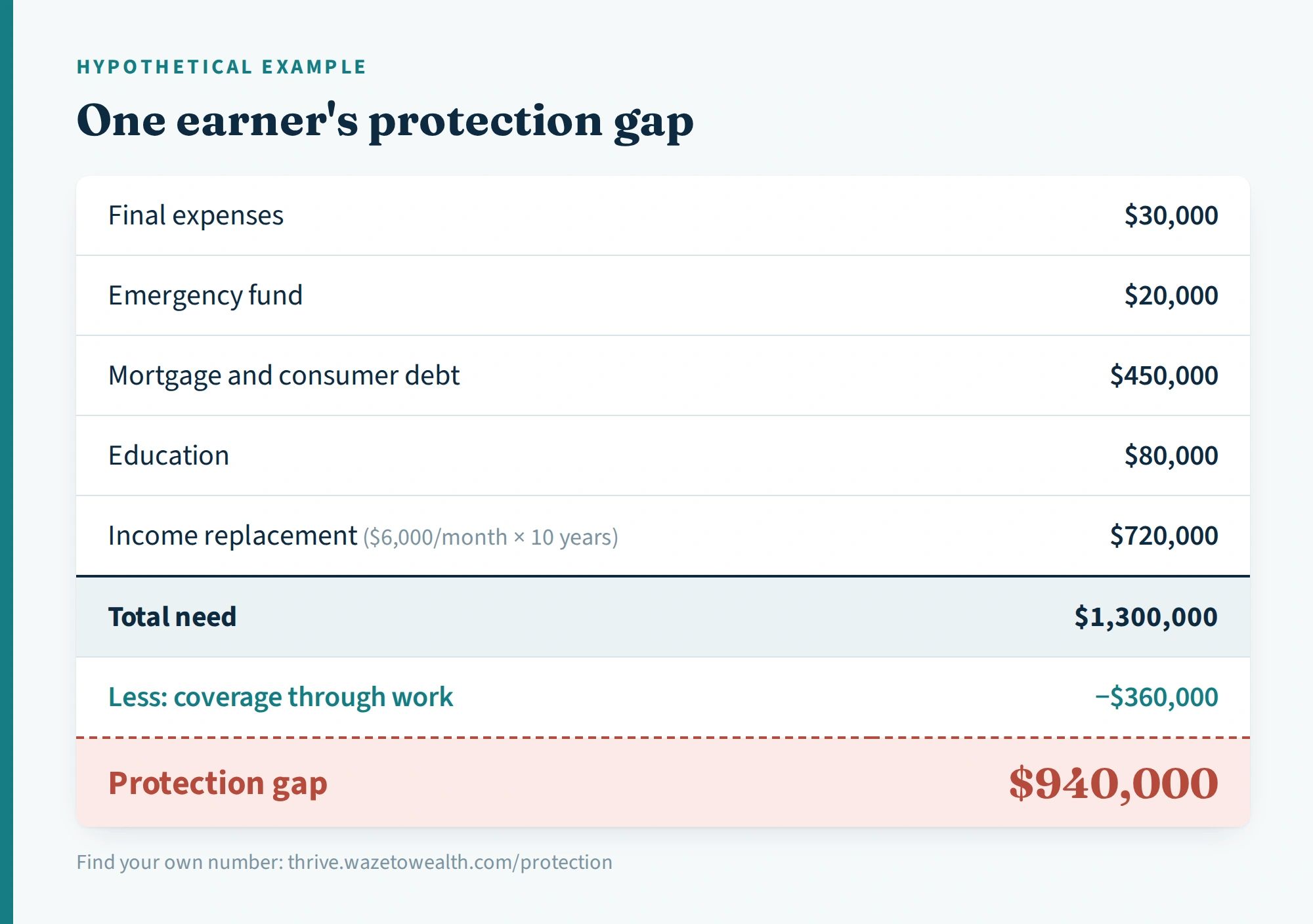
*“Hypothetical example: $1,300,000 total need minus $360,000 of work coverage leaves a $940,000 protection gap.” *
This person believed they were covered. They had $360,000 through their employer. They were actually short $940,000.
One more thing to know about workplace coverage: it usually stays with the job. Change employers, get laid off, or retire, and that coverage may not come with you — often at the very moment your health makes new coverage harder to get.
Find your number in five minutes
You don’t have to do this math on a napkin. The free Protection Gap Calculator walks you through each need, subtracts the coverage you already have, and shows your gap instantly — for yourself, or for you and your spouse or partner side by side, with a household total.
Run your numbers here: thrive.wazetowealth.com/protection
When you’re done, you can have your results emailed to you, and book a free 25-minute protection review with me if you’d like a second set of eyes. We’ll check the assumptions behind your number and look at what it would actually cost to close the gap. Coverage is priced on your health today, so the best time to look at it is while you’re healthy.
Key Takeaways
-
A rule of thumb is a guess; your family’s real need is the sum of specific obligations.
-
Five needs make up the picture: final expenses, emergency fund, debt, education, and income replacement.
-
Run the numbers for both spouses — a stay-at-home spouse’s role has a real replacement cost.
-
Workplace coverage helps, but it’s often too small and usually stays with the job.
-
Your protection gap is what’s left after subtracting the coverage you already have.
Bottom line: You design your systems for failure so they stay up. Your family deserves the same engineering. Take five minutes, find your real number, and close the gap while you can still qualify at today’s rates.
This article is for educational purposes only. The example above is hypothetical and not a guarantee of insurability, pricing, or a formal financial needs analysis, and it is not tax, legal, or investment advice. Talk with Tom Southard, CRC™ (Southard Insurance Services, LLC) to review your full picture before making any decisions.